
K-Beauty Isn’t a Trend to Me. It’s the Way Beauty Keeps Getting Better
For years, I’ve watched K-beauty move from something beauty insiders were excited about to something you can find almost everywhere. Korean skincare is no longer something you have to hunt down online, and terms like glass skin, skin barrier and cushion makeup have become part of the everyday beauty conversation.
But here’s the thing: I never really saw K-beauty as a trend.
I’ve been using Korean beauty products for years, and I even had my own online K-beauty store at one point. So for me, the appeal has never been about chasing whatever Korean skincare product happens to be going viral on TikTok or Instagram.
It’s the innovation.
And that is what I think is worth paying attention to.
What Makes K-Beauty Different?
One of the things I’ve always appreciated about Korean beauty is how much attention goes into the experience of using a product.
Texture matters. Layering matters. Hydration matters. The way a product sits on the skin matters.
There’s also a willingness to rethink familiar categories. A toner doesn’t necessarily have to feel like the old-school, watery product many of us grew up with. A foundation can lean into skincare. A moisturizer can be designed around barrier support. And products can be incredibly lightweight without feeling like they aren’t doing much.
That doesn’t mean every K-beauty product is revolutionary. It isn’t.
But the category has consistently pushed beauty brands to think beyond simply making another version of the same product.
And I think Western beauty has taken notice.
The Skin-First Approach Has Changed Beauty
If there is one K-beauty influence that I think has had staying power, it’s the shift toward skin-first beauty.
The goal isn’t necessarily to cover your skin with more makeup. It’s to make skincare itself a bigger part of the beauty conversation.
That philosophy fits where consumers are now. We have become much more interested in ingredients, hydration, skin barrier care and how our skin actually feels, not just how it looks for a few hours.
You can see that influence across the beauty industry, from skincare-infused complexion products to lightweight makeup and formulas designed to give skin a more natural finish.
And honestly, I’m here for it.
Why I Keep Coming Back to K-Beauty
My current routine is a pretty good example of why I continue reaching for Korean products.
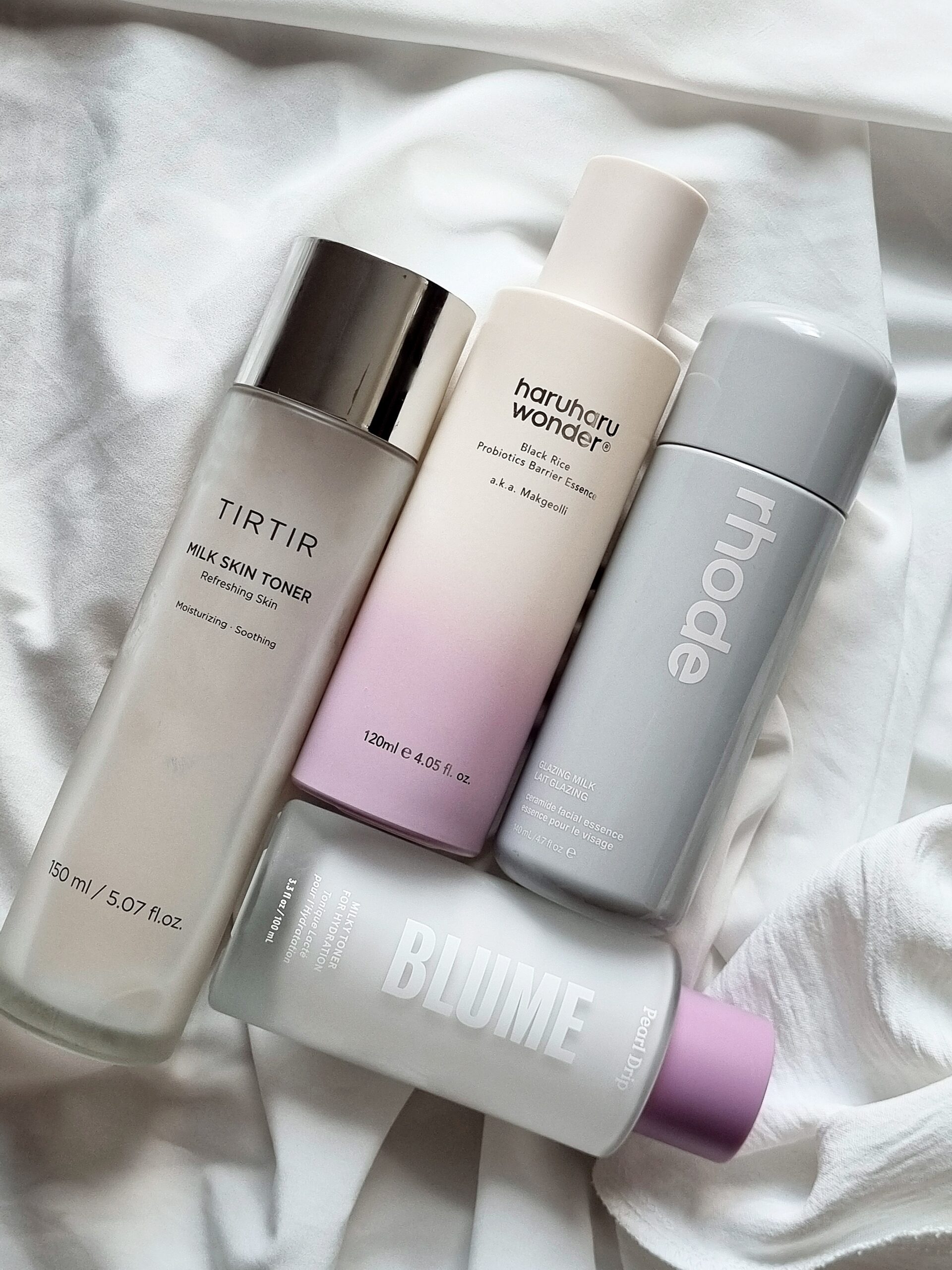
I’m currently using the TIRTIR Milk Skin Toner, several products from Haruharu wonder’s Black Rice Probiotics Barrier line, COSRX Snail Essence, Dr. Althea 345 Relief Cream, and AESTURA ATOBARRIER365 products.
They’re not all doing the same thing, and that’s exactly the point.
Some are focused on hydration, some on barrier care and some have completely different textures and finishes. What they have in common is that I actually enjoy using them.
For me, that’s always been the test.
A product can be trending everywhere, have beautiful packaging and have thousands of people talking about it. If I don’t enjoy putting it on my skin, I’m probably not going to keep using it.
K-Beauty Doesn’t Need to Be Perfect to Be Influential
I also don’t think K-beauty needs to be put on a pedestal.
There are plenty of Korean products that won’t work for everyone. Some launches are more interesting than others, and not every viral ingredient deserves a permanent place in your routine.
That’s true of beauty everywhere.
What I do think is difficult to ignore is the influence Korean beauty has had on the way we shop for and think about skincare.
The global numbers back that up, too. NielsenIQ reported in July 2026 that K-beauty value sales had increased 53% year over year, with sales up 131% over two years. That’s considerably more than a tiny social-media moment.
And we’re still seeing Korean beauty brands innovate around formats, textures and skincare concerns rather than simply relying on the novelty of being Korean.
So, Is K-Beauty Here to Stay?
I think so.
Not because every Korean beauty trend will last. It won’t.
The viral products will change. Ingredients will come and go. There will always be a new “must-have” product making the rounds online.
But the bigger ideas that K-beauty has helped popularize; hydrated skin, thoughtful formulations, barrier care, skincare-meets-makeup and products that are genuinely pleasant to use aren’t going anywhere.
Those ideas have already become part of the wider beauty industry.
And that’s why I don’t really think of K-beauty as a trend.
For me, it’s simply one of the places I continue to look when I want to discover what’s next in beauty.
Shop My Current K-Beauty Favourites →
These are some of the Korean beauty products I’m actually using right now, not a random list of viral products I found online.
TIRTIR Milk Skin Toner — A milky, hydrating toner that has become part of my current rotation. TIRTIR describes the formula as containing niacinamide, rice bran extract, ceramide and panthenol.
Haruharu wonder Black Rice Probiotics Barrier Essence — One of my current favourites, particularly when I’m looking for that comfortable, hydrated feel.
Haruharu wonder Black Rice Barrier Mist + Moisturizing Cream — Two more products I’ve been reaching for from the same barrier-focused line.
COSRX Snail Essence — Another product currently in my rotation.
Dr. Althea 345 Relief Cream — A longtime K-beauty product that continues to earn a place in my routine.
AESTURA ATOBARRIER365 Cream + Serum — The cream in particular is built around high-density ceramide capsules and is designed to support the skin barrier and hydration.